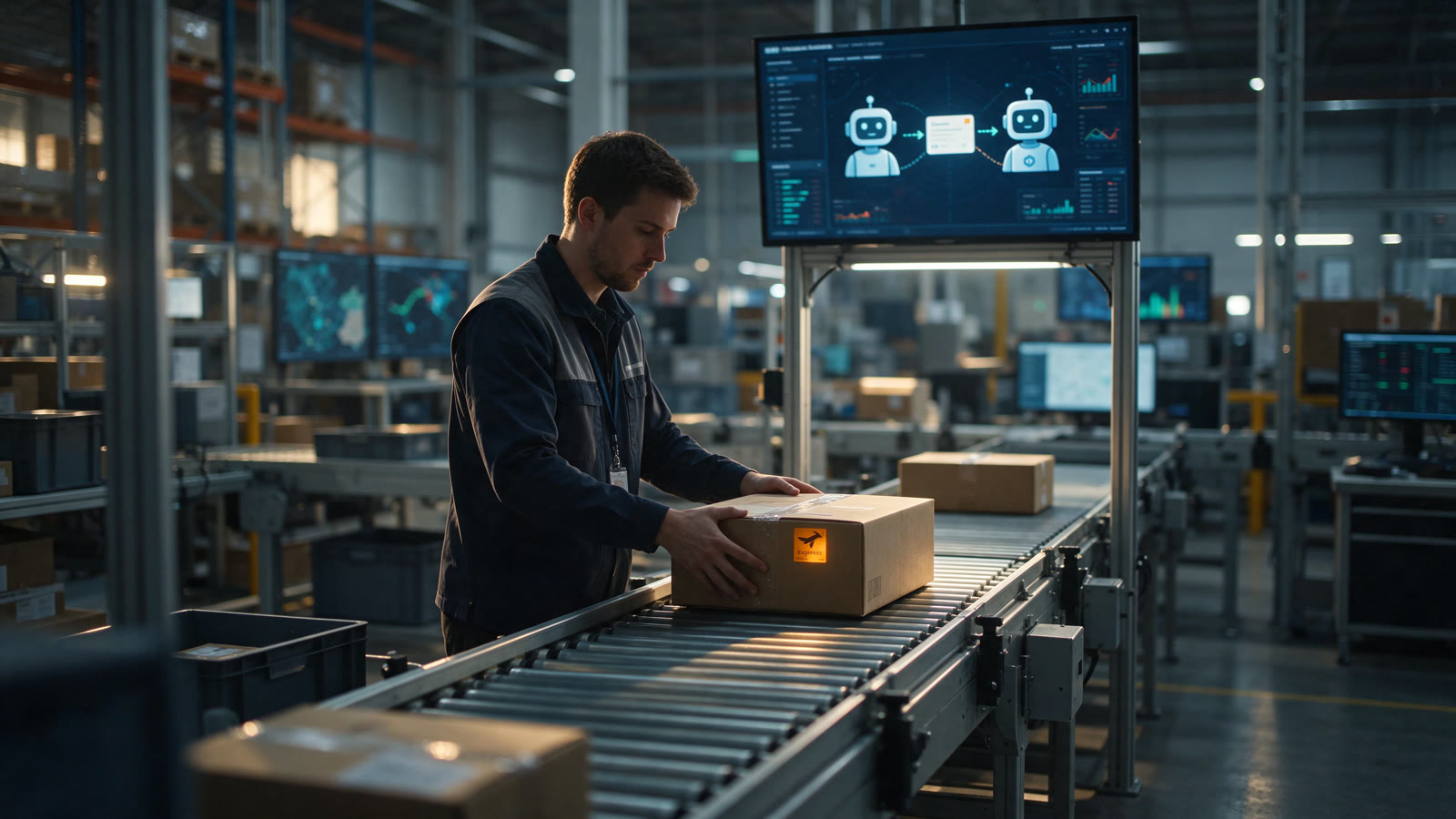
A tracking blackout is when shipments move normally but their scan events stop reaching you. Labels are created, parcels are collected and delivered, and the order page stays at label created. It goes unseen because an event that does not arrive raises no error: the label call succeeded and the event endpoint is healthy and idle. The first people to notice are customers asking where their order is, and the answers they get are wrong.
- A carrier integration has two halves. Creating labels fails loudly. Receiving events fails by going quiet.
- Missing events do more than hide parcels. They stall everything triggered by delivery: notifications, seller payouts, refund rules.
- Watch events per label by carrier. An absence only shows against an expectation.
A parcel nobody in the conversation can find
A parcel that cannot be followed is hard to resolve, because nobody in the conversation can answer the first question. The customer does not know where it is. The support agent does not know either. The carrier knows, and is not in the room.
Many things can leave a parcel untraceable: a label never scanned at collection, a handover between carriers, a damaged barcode. This guide is about one cause that sits inside the marketplace's own integration and affects every parcel on a carrier at once.
Two halves of one integration
A carrier integration sends and receives. Outbound, it asks for a label and gets a tracking number back. Inbound, it receives scan events as the parcel moves: collected, in transit, out for delivery, delivered. The two halves can be built at different times and sit on different versions of the carrier's interface.
Suppose the carrier retires an old version. Label creation is moved to the new one, because it would otherwise stop working and everyone would know. Event delivery is assumed to follow. It does not: on the new version events must be subscribed to again, or they carry an identifier in a form the receiving code cannot match to an order. Labels print, parcels travel, and no event is ever attached to a shipment.
An absence is not an error
- The carrier API returns a created label for every request.
- The event endpoint is up, with no failures, because nothing is arriving to fail.
- The shipping dashboard shows the usual number of orders shipped.
- On-time delivery is calculated over parcels with a delivery event. With fewer events the denominator shrinks and the rate holds.
- The support agent reads “label created” and tells the customer the parcel has not been collected yet.
What stalls downstream
In a marketplace the delivery event is a trigger as well as a status. Without it, customers get no dispatch or delivery messages. Sellers whose payout is released on delivery wait for an event that will not come. A rule that refunds orders showing no movement after a set number of days starts refunding parcels that are sitting on doorsteps, and reshipments go out for orders that already arrived. One missing feed lets down both sides of the marketplace.
Uptime checks ask whether the door is open. This failure needs a different question: given the labels created yesterday, how many first scans should have arrived by now, and how many did? A carrier whose answer drops to none while its label count is unchanged has not stopped collecting parcels.
The records that settle it
- events received per label, by carrier and by label creation date
- labels with no first scan after your normal collection interval, by carrier
- “where is my order” contacts by carrier
- refunds and reshipments for orders the customer later says arrived
- seller payouts held awaiting delivery, by carrier
- the carrier's version notice, and the date your label calls moved
A sample of affected tracking numbers checked by hand on the carrier's own site closes the question: the parcels are moving, and the events exist somewhere you are not reading.
Sizing it
The unit of loss is support contacts and refunds.
- Count labels created since the change that have no scan event beyond your normal first-scan interval.
- Count the contacts raised against those orders and multiply by your cost per contact.
- Add refunds and reshipments issued against them, and mark those where the original parcel was in fact delivered.
- Add seller payouts delayed, by value and by days late, since those sellers will ask too.
Why it comes back
Carriers change their interfaces on their own schedule, and each migration is planned around the half that fails loudly. If an earlier blackout was closed by re-registering an endpoint, and no check was added for events per label, the next version change, credential rotation or new event type has the same quiet path open to it.
What fixes it, and who owns each part
- Carrier integrations team: restore the event feed, backfill events for affected labels, and add a standing check on events per label by carrier.
- The carrier: an escalation with dated evidence and a request for the change notice.
- Support operations: pause the no-movement refund rule for that carrier until events are backfilled, and write to affected customers.
- Seller operations: release held payouts once deliveries are confirmed.
- The support agent's next release: an eval case. When a carrier has sent no events for any recent label, it must say tracking is unavailable, not that the parcel is uncollected.
Where Traxivo fits
Traxivo reads label records, carrier events, support tickets, refund and payout records and agent traces through read-only connections, and links them into one issue with a history. It recognises a repeat of an earlier blackout, names the owners, and drafts the carrier escalation and customer notes for a named person to approve. It does not change refund rules or release payouts. Tracking blackout is one of the ten failure patterns on the marketplaces page; see also every industry we cover.
The ten use cases on the Traxivo for Marketplaces page are the ones most mobility, logistics and marketplaces estates share. Your niche will have failures of its own. We build custom solutions for those on top of the same platform: connectors for the feeds only your niche has, detection for the pattern only your estate shows, and the loss counted in your own unit. The same approach extends to niches such as grocery and quick-commerce delivery, freight and last-mile brokerage, micromobility and rental fleets and home-services marketplaces.
Sources
- Ingrid (survey by Savanta). What UK shoppers want from delivery, returns and AI in 2027, 2026.
- Chartered Institute of Logistics and Transport (UK), reporting InPost research. InPost Research Highlights Structural Flaws in UK Parcel Delivery, 2026.
- TechCrunch. Amazon agrees to pay consumers $309M in returns policy settlement, 2026.
Every figure on this page comes from the published source it is linked to and describes the industry at large. None is a Traxivo or customer result.
Frequently asked questions
Why does a missing tracking feed not raise an alert?
Because nothing fails. Label requests succeed, and an endpoint that receives no events records no errors. Unless something compares events received with labels created, silence looks the same as a quiet day.
How can I tell a tracking blackout from parcels that really are stuck?
Check the scope and the carrier's own record. Stuck parcels are scattered across carriers and routes. A blackout affects every label for one carrier from one date, and a hand check of a few tracking numbers on the carrier's site shows the parcels moving.
What else depends on delivery events besides the tracking page?
Anything triggered by delivery: customer notifications, seller payouts released on delivery, return windows, review requests and automatic refund rules. When events stop, each of these either stalls or fires wrongly.
Stop rediscovering the same integration failure
Traxivo links the alerts, tickets and email threads your teams already produce into one history per issue, recognises when a fault returns, and drafts the follow-up with the evidence attached. Nothing is sent until a person approves it.
See how Traxivo works See Traxivo for Marketplaces