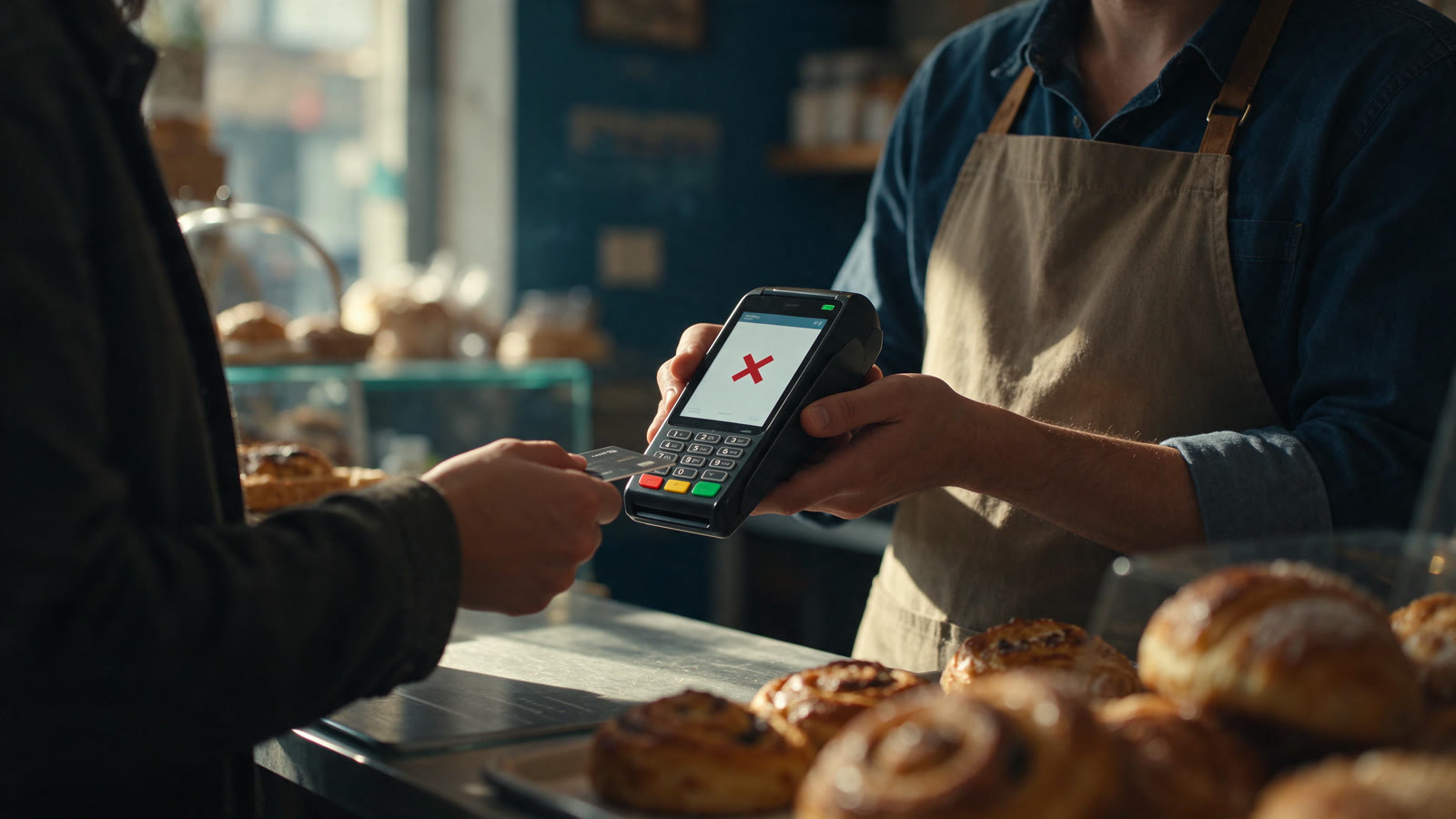
An AI shopping agent fills a basket and reaches checkout, where the shop's bot protection challenges or blocks the session. No payment is attempted. If the agent judges success by the steps it took and not by a confirmation from the shop, it reports the order as placed. Bot protection records a blocked bot, the storefront records an abandoned basket, and payments records nothing, because a sale that was never attempted leaves no trace there.
- The refusal may be deliberate and correct. The failure is that nobody decided it, nobody counts it, and the customer was told the opposite.
- Payments monitoring watches attempts. A checkout stopped before authorisation never becomes one.
- The eval case: no order placed without the shop's own confirmation, and no attempt to get past a challenge.
A sale that ends before payment begins
A customer asks an AI shopping agent to buy something. The agent finds the product, adds it to a basket and works through the checkout form. At some point before payment, the shop's bot protection scores the session as automated and responds as it is built to: a challenge page, a silent block, or a redirect back to the basket.
The refusal can come at the first page load, at the basket or at the final step. Wherever it lands, no authorisation request is ever sent. From the payment system's point of view, nothing happened.
What the agent says next depends on how it was built. One that looks for an order confirmation reports that it could not complete the purchase. One that judges success by its own actions, having pressed the final button and received a page with no error code, reports “order placed”. The customer stops shopping and waits for a delivery that is not coming.
A refusal can be the right answer
Bot protection exists for good reasons: automated stock grabbing, card testing, scraping. A shop is entitled to refuse automation it does not recognise, and may choose to admit some identified agents while turning others away. None of that is a defect.
The failure is narrower. The refusal was a default nobody examined for this kind of traffic, the customer was told the opposite of what happened, and no report on either side counts the sale that did not occur.
Why both sides report success
- The agent logs a completed task.
- Bot protection logs an automated session challenged, which is its job done.
- The storefront logs an abandoned basket, one among many.
- Payments shows a normal authorisation rate, because the rate is calculated over attempts and this was never one.
- Customer service receives a “where is my order” contact days later, finds no order, and closes it as a customer mistake.
Almost every payments measure has attempts as its denominator. A sale stopped before authorisation is absent from all of them. It can only be seen by starting further back, with the sessions that reached checkout, and asking how many produced an authorisation request at all.
The evidence sits on two sides
Part of the record belongs to whoever operates the agent, and part to the shop or its commerce platform:
- Agent traces ending in “order placed” with no order number captured from the shop.
- Challenge and block entries in the bot-protection log for the same sessions, at the same moments.
- Baskets that reached the payment step with no authorisation request following.
- Customer contacts about orders that do not exist, from the same customers.
Each party holds half of a timeline that only makes sense whole. A platform that hosts the storefronts and receives the agent traffic may hold all four. Otherwise, the first conversation between the two sides is the investigation.
Sizing it
The unit of loss is agent-originated sales that never reached payment. Whichever side you sit on:
- Count agent sessions that reached checkout, from agent traces or from identified agent traffic in storefront logs.
- Count those that met a challenge or block and produced no authorisation request.
- Multiply by basket value at the point of refusal. That is the demand turned away.
- Separate the sessions the agent reported as placed. Each is a misinformed customer and a support contact.
- Split the result by storefront and by protection rule, to see where a decision is needed.
The third number is not automatically a loss to recover. Some of it is traffic the shop meant to refuse. Sizing it is what turns a default into a decision.
Why it comes back
Both sides keep moving. Protection rules are updated, sometimes by their vendor with no release on the shop's side, and each new agent version browses a little differently. An allowance made for one agent identity does not cover the next version or the next rule set, and neither party tests against the other.
What fixes it
- Agent team: an eval case the next release must pass. The agent reports an order as placed only when it holds the shop's own confirmation. When challenged, it stops, says plainly that the shop did not accept the checkout, and hands back to the customer. It does not try to get past the challenge.
- Shop security and e-commerce owners: decide deliberately which agents may check out and how they identify themselves, and make a refusal unambiguous.
- Commerce operations: report agent sessions from checkout reached to authorisation attempted, alongside the usual payment measures.
- Customer service: contact the customers who were told an order existed.
Where Traxivo fits
Traxivo reads the agent traces, challenge logs, order and authorisation records and support contacts your systems already produce, through read-only connections. It links them into one issue with a history, recognises when the dead ends return, names the owners on each side, and drafts the follow-ups for a named person to approve. It does not alter protection rules or place orders. The failure becomes an eval case the agent's next release must pass. Agent checkout dead ends are one of the ten payments failure patterns we describe, and agents that report done when the outcome failed appear on our other industry pages.
The ten use cases on the Traxivo for Payments page are the ones most payments and commerce estates share. Your niche will have failures of its own. We build custom solutions for those on top of the same platform: connectors for the feeds only your niche has, detection for the pattern only your estate shows, and the loss counted in your own unit. The same approach extends to niches such as stored-value and gift card programmes, fuel forecourts and unattended kiosks, restaurant and hospitality point of sale and marketplaces paying out sellers.
Sources
- Web analytics vendor report. We Tested 120+ AI Shopping Prompts. Here’s What Agentic Shopping Actually Does (and Where It Breaks), 2026.
- Vendor audit of retail sites. Would You Let a Bot Shop For You?, 2026.
- NielsenIQ, citing Morgan Stanley. 120 Million AI Pay Transactions in a Single Week: AI Shopping Agents Move From Theory to Checkout, 2026.
- NielsenIQ. 120 Million AI Pay Transactions in a Single Week: AI Shopping Agents Move From Theory to Checkout, 2026.
Every figure on this page comes from the published source it is linked to and describes the industry at large. None is a Traxivo or customer result.
Frequently asked questions
Why would an AI shopping agent say an order was placed when it was not?
If the agent judges success by the steps it carried out and not by a confirmation from the shop, a challenge or block page that loads without an error can look like the end of a successful checkout. Requiring the shop's own order confirmation before reporting success closes that gap.
Is it wrong for a shop to block shopping agents?
No. Refusing automation it does not recognise is a legitimate choice, and a shop may admit some identified agents while refusing others. The problem described here is a refusal nobody chose on purpose, that nobody measures, and that the customer is not told about.
Why do payment dashboards not show these lost sales?
Because they measure authorisation attempts. A checkout that is stopped before payment never produces an attempt, so approval and decline rates are unaffected. The loss is visible only by comparing sessions that reached checkout with authorisation requests made.
Stop rediscovering the same integration failure
Traxivo links the alerts, tickets and email threads your teams already produce into one history per issue, recognises when a fault returns, and drafts the follow-up with the evidence attached. Nothing is sent until a person approves it.
See how Traxivo works See Traxivo for Payments